TMS vs. Neurofeedback: How to Choose the Right Brain-Based Therapy for You
Quick Answer Both TMS (Transcranial Magnetic Stimulation) and neurofeedback offer non-invasive, drug-free approaches to mental health treatment. TMS uses magnetic fields to stimulate specific brain areas and is FDA-approved for major depressive disorder, treatment-resistant depression and obsessive-compulsive disorder (OCD) [1,2], while neurofeedback trains your brain to self-regulate through real-time brainwave monitoring [3]. The right choice… Read more

Reviewed by The PsychPlus Team
November 4, 2025
Quick Answer
Both TMS (Transcranial Magnetic Stimulation) and neurofeedback offer non-invasive, drug-free approaches to mental health treatment. TMS uses magnetic fields to stimulate specific brain areas and is FDA-approved for major depressive disorder, treatment-resistant depression and obsessive-compulsive disorder (OCD) [1,2], while neurofeedback trains your brain to self-regulate through real-time brainwave monitoring [3]. The right choice depends on your specific condition, treatment goals, and personal preferences. Responses vary significantly between individuals due to factors like genetics, severity of symptoms, and treatment history
Are you feeling overwhelmed trying to choose between brain-based therapies like TMS and neurofeedback? You’re not alone in wondering which treatment might work best for your mental health needs. Many people find themselves comparing these two innovative approaches, especially when traditional treatments haven’t provided the relief they’re seeking.
Both TMS and neurofeedback target brain function directly, but they work in completely different ways. This evidence-based guide will help you understand how each therapy works, who they’re designed for, and the practical considerations that can help you make an informed decision about your mental health care.
Disclaimer: This content is for informational purposes and is not a substitute for medical advice. Always consult with a qualified healthcare provider before starting any treatment.
Understanding the Basics
What Is Transcranial Magnetic Stimulation (TMS)?
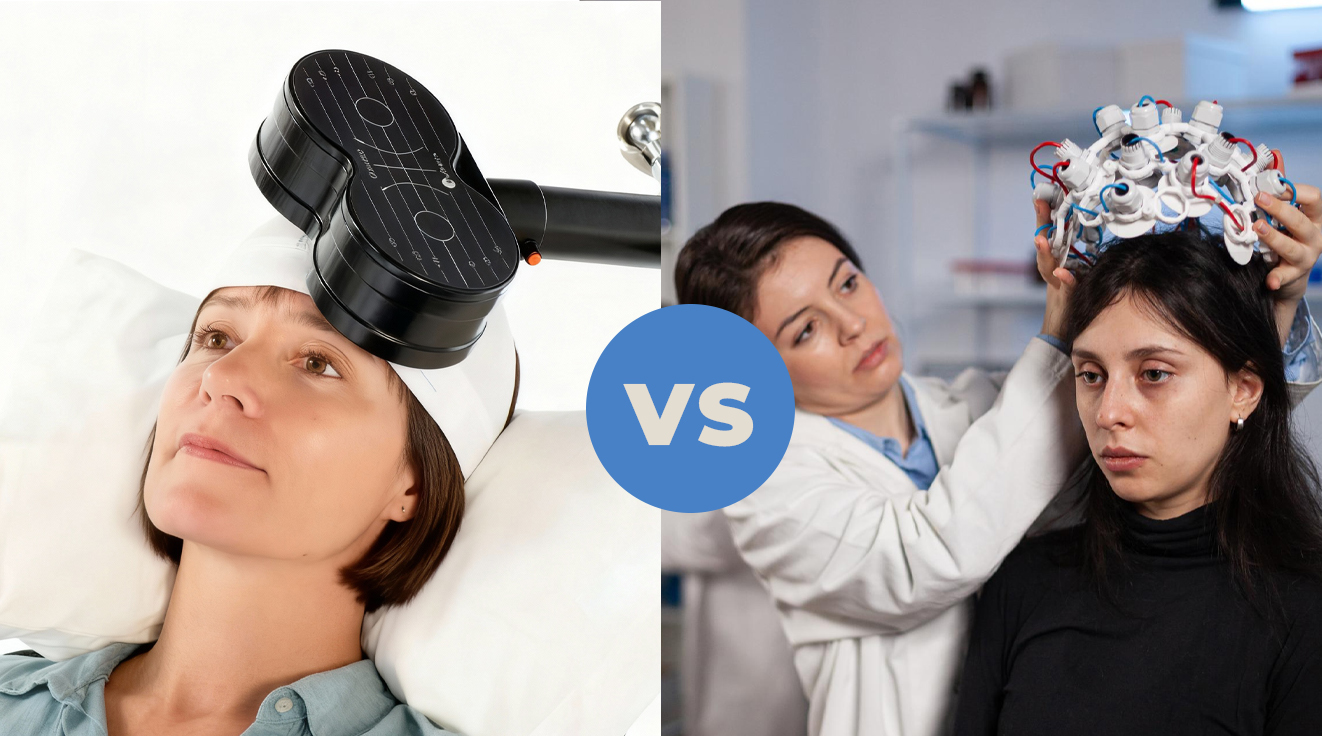
Transcranial magnetic stimulation uses magnetic fields to stimulate nerve cells in specific brain areas [4]. During treatment, a technician places a magnetic coil against your scalp that generates brief magnetic pulses, stimulating brain tissue underneath and targeting areas linked to mood regulation, particularly the prefrontal cortex [5].
TMS has FDA approval for treating major depressive disorder and OCD [6]. It received initial clearance for treatment-resistant depression in 2008 and OCD approval in 2018 [7]. The treatment is especially valuable for people with treatment-resistant depression who haven’t found relief from traditional medications [8]. Research suggests that nearly half of people with treatment-resistant depression improve with TMS, and about one in five experience full remission of symptoms. [18].
What Is Neurofeedback Therapy?
Neurofeedback therapy, also called EEG biofeedback, trains your brain to function more efficiently by showing you real-time information about your brain activity [3]. Sensors on your scalp monitor brainwave patterns, which you watch on a screen in the form of games or videos. When your brain produces desired patterns, you receive positive feedback [9].
Over time, your brain learns to produce healthier patterns independently, improving emotional regulation, focus, and overall brain function without external stimulation [10]. Individual responses to neurofeedback vary widely, with some people noticing changes within 10-15 sessions while others may need 30-40 sessions to see meaningful improvements. [10]
How Each Treatment Works
TMS: Magnetic Fields and Mood Regulation
TMS delivers focused magnetic pulses to specific brain regions, causing neurons to fire and either increasing or decreasing activity in targeted areas [11]. For depression, TMS typically targets the left prefrontal cortex, an area often underactive in major depressive disorder [12]. The magnetic field strength is similar to an MRI scan, requires no anesthesia, and you remain conscious throughout [13].
Research shows TMS creates lasting changes in brain connectivity and neurotransmitter function, explaining why many people experience sustained improvements after treatment ends [14]. However, responses differ significantly between individuals. Factors like age, brain anatomy, and medication history can all influence how well someone responds to TMS.
Neurofeedback: Real-Time Brainwave Training
Neurofeedback works on operant conditioning principles, meaning your brain learns through positive reinforcement [15]. Different brainwave frequencies correspond to different mental states: beta waves relate to focused attention, while alpha waves indicate relaxed awareness. Training can increase or decrease specific frequencies based on your needs [16].
Unlike TMS, neurofeedback doesn’t directly stimulate brain tissue but helps existing neural networks function more efficiently through guided practice [17]. The learning process is highly individual. Some people have naturally more flexible brainwave patterns and may progress faster than others.
Conditions Each Therapy Targets
Depression, Anxiety, OCD, PTSD
TMS Applications: TMS has strong FDA backing for major depressive disorder and OCD. Research shows significant improvement rates for treatment-resistant depression. A recent meta-analysis of 19 studies revealed that nearly 40% of TRD patients responded to TMS while it also found that 36% of patients achieved remission in 9 analyzed studies. [31]
Neurofeedback Applications: Neurofeedback effectively treats anxiety, PTSD, and emotional regulation challenges. Systematic reviews found clinically meaningful PTSD symptom improvements with lasting effects beyond treatment [20]. For depression, neurofeedback may help as part of comprehensive treatment plans, though it typically takes longer than TMS to show results [21].
ADHD, Sleep Issues, Cognitive Performance
Neurofeedback has extensive ADHD research support, especially in children and adolescents. Meta-analyses show standard protocols (theta/beta, sensorimotor rhythm, slow cortical potential) are “efficacious and specific” for ADHD treatment [22]. It also excels at addressing sleep problems and cognitive performance by training individuals to modulate their brainwave patterns [23].
TMS for ADHD is still being researched with promising early results but isn’t yet a standard treatment option [24].
What to Expect from a Session
TMS Sessions
Standard TMS sessions last 20-40 minutes with magnetic pulses delivered in specific patterns [25]. You’ll hear clicking sounds and may feel tapping sensations on your scalp. Most people find these tolerable, though some experience initial mild discomfort that typically decreases over the first few sessions[13]. A typical course involves sessions five days per week for 4-6 weeks, totaling 20-30 treatments [19].
Neurofeedback Sessions
Neurofeedback sessions last 30-60 minutes with sensors monitoring brainwave activity (they only read signals, not send them) [10]. You’ll watch real-time brain activity displays and receive positive feedback when producing target patterns [3]. Sessions are relaxing and enjoyable, typically requiring 20-40 sessions depending on individual goals and progress rates [26].
Benefits, Drawbacks, and Safety
Side Effects and Risks
TMS: Common side effects include scalp discomfort, headaches, and facial muscle twitching that usually decrease over time [25]. The most serious risk is seizures, occurring in less than 0.1% of patients [13]. TMS isn’t suitable for people with certain metal implants near the head [27].
Neurofeedback: Has minimal side effects since it doesn’t directly stimulate the brain [10]. Some may experience temporary fatigue or mild headaches as the brain adapts, with rare temporary mood changes that typically resolve [3].
Who Should Consider Each?
Consider TMS if you:
- Have treatment-resistant depression or OCD
- Want faster results (weeks rather than months)
- Prefer structured, time-limited treatment
- Have tried multiple medications unsuccessfully
Consider Neurofeedback if you:
- Want to develop long-term self-regulation skills
- Prefer gentle, non-invasive approaches
- Have ADHD, anxiety, or sleep issues
- Want to avoid medication side effects
Keep in mind that individual factors like your specific symptoms, lifestyle, and treatment preferences will ultimately guide which option might work best for you.
Cost, Insurance, and Accessibility
TMS coverage varies by insurance but many plans now cover FDA-approved uses for treatment-resistant depression and OCD. Medicare and some Medicaid programs provide coverage when medical necessity criteria are met [28]. Prior authorization is typically required.
Neurofeedback coverage is more limited, with some plans covering it for conditions like ADHD but many considering it experimental [29]. Coverage is more likely when provided by licensed healthcare professionals and for FDA-recognized conditions.
TMS requires daily clinic visits for several weeks, while neurofeedback offers more scheduling flexibility but requires longer-term commitment. Both require specialized providers, which may be limited in rural areas.
Making the Right Choice
Personal Factors to Weigh
Consider these factors when choosing:
Severity and Type: TMS may suit severe, treatment-resistant depression better, while neurofeedback might work better for anxiety and attention issues.
Timeline: TMS typically works faster; neurofeedback builds lasting skills over time.
Treatment Philosophy: Prefer medical intervention (TMS) or skill-building approach (neurofeedback)?
Lifestyle: Consider your schedule, transportation, and commitment ability.
Remember that responses to both treatments vary significantly between individuals. What works well for one person may not be the best fit for another.
When to Consult a Professional
Both treatments require professional evaluation. Consult a qualified mental health provider if experiencing:
- Persistent depression unresponsive to medication
- Anxiety interfering with daily functioning
- ADHD symptoms affecting work or relationships
- Sleep problems impacting quality of life
Frequently Asked Questions
Q: Is TMS or neurofeedback better for anxiety and PTSD?
Both can be effective but work differently. TMS has stronger FDA backing for depression and OCD, while neurofeedback may better suit anxiety, emotional regulation, and trauma-related symptoms [20]. Neurofeedback is often preferred for younger patients and those hoping to develop long-term coping skills. Individual responses vary, so the “better” choice depends on your specific symptoms and treatment goals.
Q: How soon will I see results?
TMS typically shows results within 2-6 weeks [18]. Neurofeedback often takes longer, usually 10-20 sessions, but builds lasting self-regulation skills [30]. Individual responses vary significantly. Individual responses vary significantly. Some people notice improvements earlier while others may need more time to see meaningful changes.
If you’re considering TMS or neurofeedback and aren’t sure which is right for you, PsychPlus can help. Our expert clinicians provide personalized, evidence-based care, whether in person or online. We accept most insurance, including Medicare and Medicaid, and offer same-day or next-day appointments.
You deserve to feel better, and finding the right treatment approach is an important step in your mental health journey. Start your journey toward better mental health today at psychplus.com.
References
- Shi, R., Wang, Z., Yang, D., et al. (2024). Short-term and long-term efficacy of accelerated transcranial magnetic stimulation for depression: a systematic review and meta-analysis. BMC Psychiatry, 24, 109. https://pubmed.ncbi.nlm.nih.gov/38326789/
- U.S. Food and Drug Administration. FDA permits marketing of transcranial magnetic stimulation for treatment of obsessive compulsive disorder. https://www.fda.gov/news-events/press-announcements/fda-permits-marketing-transcranial-magnetic-stimulation-treatment-obsessive-compulsive-disorder
- Gruzelier, J. H. (2014). EEG-neurofeedback for optimising performance. I: A review of cognitive and affective outcome in healthy participants. Neuroscience and Biobehavioral Reviews, 44, 124-141. https://www.sciencedirect.com/science/article/abs/pii/S0149763413002248
- Klomjai, W., Katz, R., & Lackmy-Vallée, A. (2015). Basic principles of transcranial magnetic stimulation (TMS) and repetitive TMS (rTMS). Annals of Physical Rehabilitation Medicine, 58(4), 208-213. https://pubmed.ncbi.nlm.nih.gov/26319963/
- George, M. S., Lisanby, S. H., Avery, D., et al. (2010). Daily left prefrontal transcranial magnetic stimulation therapy for major depressive disorder: a sham-controlled randomized trial. Archives of General Psychiatry, 67, 507-516. https://pubmed.ncbi.nlm.nih.gov/20439832/
- Perera, T., George, M. S., Grammer, G., et al. (2016). The clinical TMS society consensus review and treatment recommendations for TMS therapy for major depressive disorder. Brain Stimulation, 9, 336-346. https://pmc.ncbi.nlm.nih.gov/articles/PMC5612370/
- O’Reardon, J. P., Solvason, H. B., Janicak, P. G., et al. (2007). Efficacy and safety of transcranial magnetic stimulation in the acute treatment of major depression: a multisite randomized controlled trial. Biological Psychiatry, 62, 1208-1216. https://pubmed.ncbi.nlm.nih.gov/17573044/
- Voigt, J. D., Leuchter, A. F., & Carpenter, L. L. (2019). Theta burst stimulation for the acute treatment of major depressive episodes: A systematic review and meta-analysis. PLoS ONE, 14(2), e0204472. https://pubmed.ncbi.nlm.nih.gov/34050123/
- Arns, M., Heinrich, H., & Strehl, U. (2014). Evaluation of neurofeedback in ADHD: the long and winding road. Biological Psychology, 95, 108-115. https://pubmed.ncbi.nlm.nih.gov/24321363/
- Marzbani, H., Marateb, H. R., & Mansourian, M. (2016). Neurofeedback: A comprehensive review on system design, methodology and clinical applications. Basic and Clinical Neuroscience, 7(2), 143-158. https://pmc.ncbi.nlm.nih.gov/articles/PMC4892319/
- Lefaucheur, J. P., Aleman, A., Baeken, C., et al. (2020). Evidence-based guidelines on the therapeutic use of repetitive transcranial magnetic stimulation (rTMS): An update (2014-2018). Clinical Neurophysiology, 131(2), 474-528. https://pubmed.ncbi.nlm.nih.gov/25034472/
- Fitzgerald, P. B., Fountain, S., & Daskalakis, Z. J. (2006). A comprehensive review of the effects of rTMS on motor cortical excitability and inhibition. Clinical Neurophysiology, 117(12), 2584-2596. https://pubmed.ncbi.nlm.nih.gov/16890483/
- Rossi, S., Hallett, M., Rossini, P. M., et al. (2009). Safety, ethical considerations, and application guidelines for the use of transcranial magnetic stimulation in clinical practice and research. Clinical Neurophysiology, 120(12), 2008-2039. https://pubmed.ncbi.nlm.nih.gov/19833552/
- Kito, S., Hasegawa, T., & Koga, Y. (2011). Neuroanatomical correlates of therapeutic efficacy of low-frequency right prefrontal transcranial magnetic stimulation in treatment-resistant depression. Psychiatry and Clinical Neurosciences, 65(2), 175-182. https://onlinelibrary.wiley.com/doi/10.1111/j.1440-1819.2010.02183.x
- Escolano, C., Aguilar, M., & Minguez, J. (2011). EEG-based upper alpha neurofeedback for cognitive enhancement in healthy humans. Conference Proceedings: Annual International Conference of the IEEE Engineering in Medicine and Biology Society, 2011, 2125-2128. https://pubmed.ncbi.nlm.nih.gov/22254807/
- Gruzelier, J. H. (2014). EEG-neurofeedback for optimising performance. II: Creativity, the performing arts and ecological validity. Neuroscience and Biobehavioral Reviews, 44, 142-158. https://pubmed.ncbi.nlm.nih.gov/24239853/
- Monastra, V. J., Lynn, S., Linden, M., et al. (2005). Electroencephalographic biofeedback in the treatment of attention-deficit/hyperactivity disorder. Journal of Neurotherapy, 9(4), 5-34. https://pubmed.ncbi.nlm.nih.gov/16013783/
- Berlim, M. T., van den Eynde, F., Tovar-Perdomo, S., et al. (2014). Response, remission and drop-out rates following high-frequency repetitive transcranial magnetic stimulation (rTMS) for treating major depression: a systematic review and meta-analysis of randomized, double-blind and sham-controlled trials. Psychological Medicine, 44(2), 225-239.https://www.cambridge.org/core/journals/psychological-medicine/article/abs/response-remission-and-dropout-rates-following-highfrequency-repetitive-transcranial-magnetic-stimulation-rtms-for-treating-major-depression-a-systematic-review-and-metaanalysis-of-randomized-doubleblind-and-shamcontrolled-trials/C82D4F2DD4823BC422524D4ED036F644
- Carpenter, L. L., Janicak, P. G., Aaronson, S. T., et al. (2012). Transcranial magnetic stimulation (TMS) for major depression: a multisite, naturalistic, observational study of acute treatment outcomes in clinical practice. Depression and Anxiety, 29(7), 587-596. https://www.sydneytms.com.au/wp-content/uploads/2015/03/Carpenter-2012_TMS_Acute_Outcomes.pdf
- Voigt, J. D., Mosier, M., & Tendler, A. (2024). Systematic review and meta-analysis of neurofeedback and its effect on posttraumatic stress disorder. Frontiers in Psychiatry, 15, 1323485. https://www.frontiersin.org/journals/psychiatry/articles/10.3389/fpsyt.2024.1323485/full
- Peeters, F., Oehlen, M., Ronner, J., et al. (2014). Neurofeedback as a treatment for major depressive disorder—a pilot study. PLoS ONE, 9(3), e91837. https://pmc.ncbi.nlm.nih.gov/articles/PMC3958393/
- Arns, M., de Ridder, S., Strehl, U., et al. (2009). Efficacy of neurofeedback treatment in ADHD: the effects on inattention, impulsivity and hyperactivity: a meta-analysis. Clinical EEG and Neuroscience, 40(3), 180-189. https://pubmed.ncbi.nlm.nih.gov/19715181/
- Sterman, M. B. (2000). Basic concepts and clinical findings in the treatment of seizure disorders with EEG operant conditioning. Clinical Electroencephalography, 31(1), 45-55. https://pubmed.ncbi.nlm.nih.gov/10638352/
- lumberger, D. M., Vila-Rodriguez, F., Thorpe, K. E., et al. (2018). Effectiveness of theta burst versus high-frequency repetitive transcranial magnetic stimulation in patients with depression (THREE-D): a randomised non-inferiority trial. Lancet, 391(10131), 1683-1692. https://www.thelancet.com/journals/lancet/article/PIIS0140-6736(18)30295-2/abstract
- Janicak, P. G., O’Reardon, J. P., Sampson, S. M., et al. (2008). Transcranial magnetic stimulation in the treatment of major depressive disorder: a comprehensive summary of safety experience from acute exposure, extended exposure, and during reintroduction treatment. Journal of Clinical Psychiatry, 69(2), 222-232. https://www.sydneytms.com.au/wp-content/uploads/2015/03/Janicak-et-al-Safety-Published-Version.pdf
- Gevensleben, H., Holl, B., Albrecht, B., et al. (2009). Is neurofeedback an efficacious treatment for ADHD? A randomised controlled clinical trial. Journal of Child Psychology and Psychiatry, 50(7), 780-789. https://pubmed.ncbi.nlm.nih.gov/19207632/
- Zangen, A., Roth, Y., Voller, B., et al. (2005). Transcranial magnetic stimulation of deep brain regions: evidence for efficacy of the H-coil. Clinical Neurophysiology, 116(4), 775-779. https://pubmed.ncbi.nlm.nih.gov/15792886/
- Centers for Medicare & Medicaid Services. Local Coverage Determination (LCD): Transcranial Magnetic Stimulation (TMS) in the Treatment of Adults with Major Depressive Disorder (L34522). https://www.cms.gov/medicare-coverage-database/search.aspx
- Hurt, E., Arnold, L. E., & Lofthouse, N. (2014). Quantitative EEG neurofeedback for the treatment of pediatric attention-deficit/hyperactivity disorder, autism spectrum disorders, learning disorders, and epilepsy. Child and Adolescent Psychiatric Clinics of North America, 23(3), 465-486. https://pubmed.ncbi.nlm.nih.gov/24975622/
- Cortese, S., Ferrin, M., Brandeis, D., et al. (2016). Neurofeedback for attention-deficit/hyperactivity disorder: meta-analysis of clinical and neuropsychological outcomes from randomized controlled trials. Journal of the American Academy of Child & Adolescent Psychiatry, 55(6), 444-455. https://pubmed.ncbi.nlm.nih.gov/27238063/
- Vida, R. G., Sághy, E., Bella, R., Kovács, S., Erdősi, D., Józwiak-Hagymásy, J., Zemplényi, A., Tényi, T., Osváth, P., & Voros, V. (2023). Efficacy of repetitive transcranial magnetic stimulation (rTMS) adjunctive therapy for major depressive disorder (MDD) after two antidepressant treatment failures: meta-analysis of randomized sham-controlled trials. BMC psychiatry, 23(1), 545. https://doi.org/10.1186/s12888-023-05033-y
Find a mental health care provider near you
Learn about the conditions we treat